A robotic arm can move a person’s hand, but movement alone doesn’t restore control. The hard part is linking the person’s intention to the machine, then returning useful feedback.
Quick read
- Brain signals can guide a computer, which sends commands to motors.
- Exoskeletons and robotic limbs still need sensors, power, fitting, and safety limits.
- The open medical question is how much useful movement people regain outside a lab.
How the control link works
Paralysis can interrupt the nerve signals that carry movement commands from the brain to the muscles. A robotic system can work around that break by reading brain activity, detecting muscle signals, or sensing movement from another part of the body.
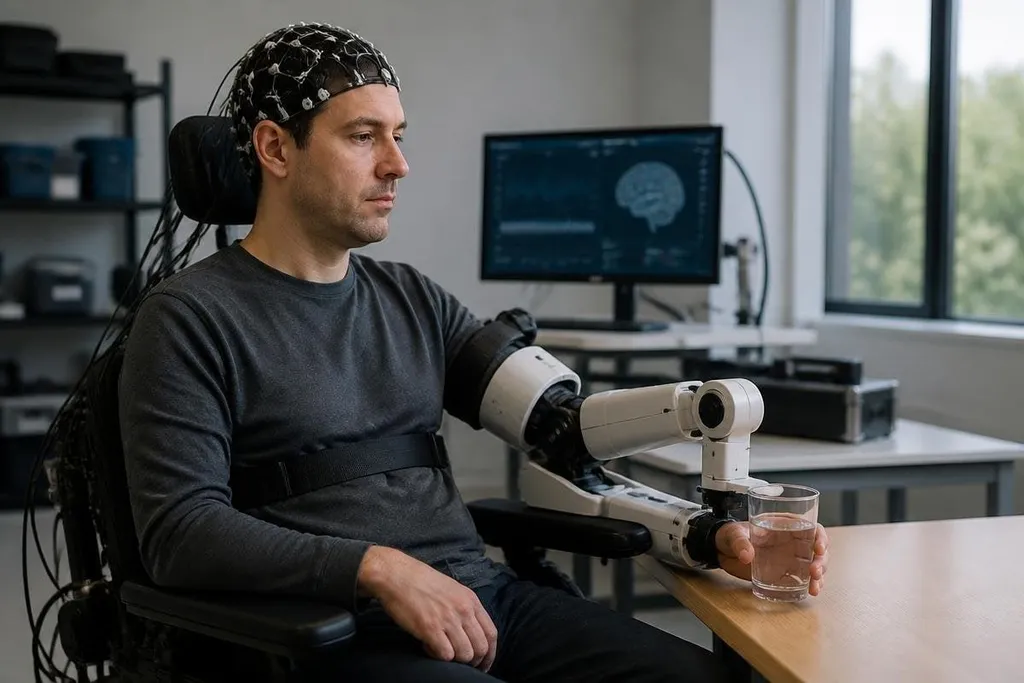
Brain-computer interfaces turn measured brain activity into commands for software. The software then sends those commands to a robotic arm, an exoskeleton, or an electrical stimulator connected to muscles. The user may think about reaching, and the system translates that intent into motor movement.
The route depends on where the injury sits and which signals remain available. A person with some muscle activity may use surface electrodes, which sit on the skin and detect electrical signals. Someone with little usable muscle control may need a different signal source, such as brain activity recorded through sensors placed on or in the body.
That distinction matters because a robotic limb cannot correct a signal it never receives. Better motors help only after the control system can separate a deliberate command from noise, fatigue, or an accidental movement.
Movement needs feedback
A person can control a hand more safely when they can feel its position, pressure, and contact with an object. Paralysis can remove or weaken that feedback, leaving the user dependent on cameras, sound, or visual attention.
Robotic systems can add sensors for force, position, and contact. A control computer can use those readings to limit grip force or stop a joint when it reaches a set boundary. The person still needs a clear way to understand what the robot is doing.
This is why a machine that completes one movement during a demonstration may still fall short in daily use.
Picking up a cup requires the system to handle shape, weight, position, grip force, and the user’s next command without forcing them to watch every motor.
A robotic limb can move a hand, but that motion alone doesn’t show restored movement. Reports from Robot24.com can tie neural-control claims to the task, patient group, test setting, and measured result. Those details matter before comparing the main robot types.
The main robot types
Several machine designs address different parts of the problem, so the device name alone tells you little about the result.
- Exoskeletons: Wearable frames move the legs or support a joint. They need a close fit, a stable power source, and controls that respond safely to changes in balance.
- Robotic limbs: Prosthetic arms and hands replace a missing limb. Their usefulness depends on command signals, joint control, grip feedback, weight, and battery life.
- Therapy robots: These systems guide repeated arm or leg movements during rehabilitation. They can record motion and adjust support, but repeated motion does not prove that natural control has returned.
- Electrical stimulation systems: Small electrical pulses activate nerves or muscles. A robot or computer may time those pulses with a person’s intended movement.
The designs can also work together. An interface may read a command, software may check it, and a stimulator or motor may create the movement. Each extra step adds another place where delay, noise, or a wrong command can affect the result.
What still needs proof
A useful system must work beyond a controlled session. It must handle changes in electrode contact, body position, muscle fatigue, clothing, lighting, and the user’s attention. It also needs a safe stop that the person or a helper can reach quickly.
Long-term use raises separate questions. Implantable sensors may need surgery and medical follow-up. Wearable systems avoid that step but can lose signal quality as the user moves. A robotic limb may restore a task in one setting and remain too heavy, slow, or difficult to control for another.
I'd treat any claim of restored movement as incomplete until the person can perform useful tasks repeatedly, with less supervision and clear safety limits. A single successful reach shows that the control loop can work once; it does not show that the system fits ordinary life.
A practical check before judging a system
Use these points when reading a trial report or product claim:
- Name the signal: Find out whether control comes from brain activity, muscle activity, a switch, or manual input.
- Check the task: Look for the exact movement tested, such as reaching, standing, walking, or gripping.
- Look for assistance: Note how much a therapist, operator, camera, or support frame helps.
- Ask about feedback: Check whether the person receives touch, force, position, or only visual information.
- Read the limit: Find the reported battery life, session length, safety stop, fitting needs, and follow-up period.
The next useful result will be measured outside a single demonstration: the same person completing daily tasks across repeated sessions, with the machine doing less of the work over time. That is the point where robotic movement starts to look like restored control rather than remote assistance.